
Village in the Shade Farming Guide: Fields, Seasons and Crop Costs
Plan fields, ridges and paddies with selected crop costs, season windows, rice timing and planting checks.
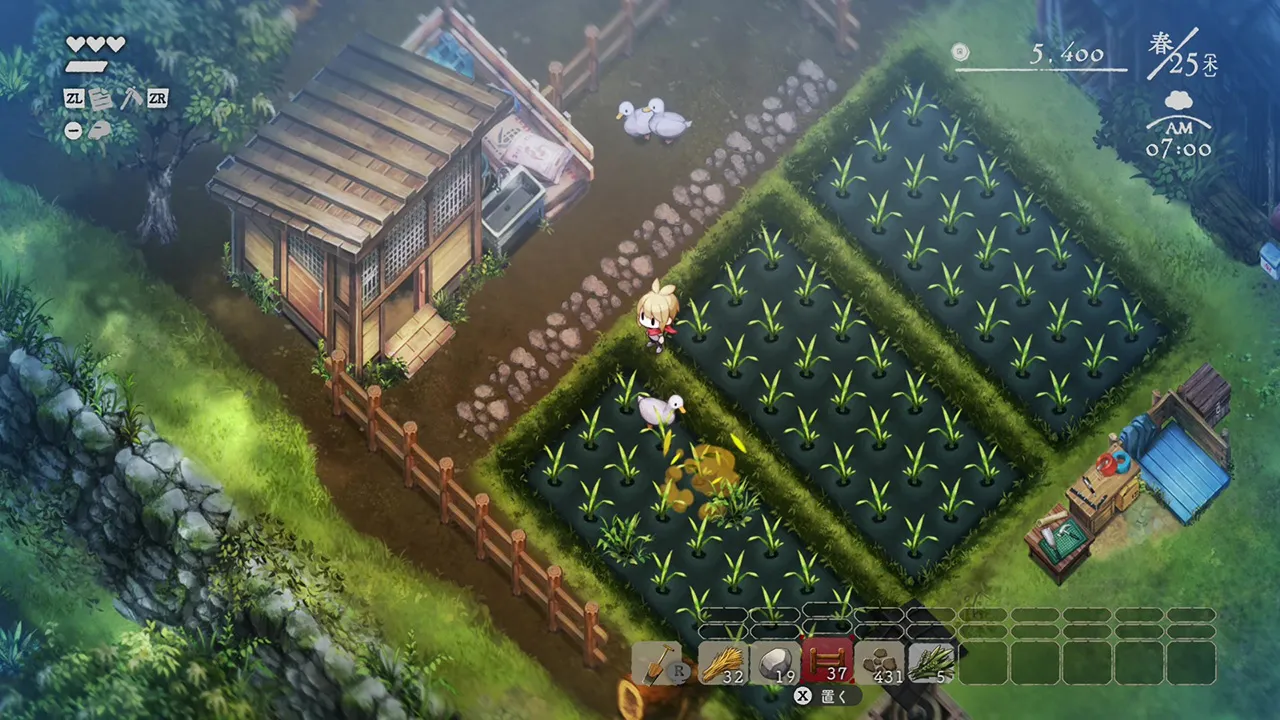
How should you plan a field, ridge, or paddy?
For Village in the Shade farming, start by matching each seed to its season and preferred growing surface. Before buying more seeds, check whether enough of the season remains for the crop’s growth time plus a margin for delays. Turnips offer a short spring cycle; tomatoes take longer to establish but can produce again; rice belongs on a separate, long-term paddy schedule.

The Perfect Farming Sim for Halloween is here! Village in the Shade · Josh's Gaming Garden
General reference: third-party English-language gameplay of the original 2026 game. This is not a dedicated tutorial for the topic below, a device benchmark, or evidence of extracted values, quest order, or Patch 1.30 behavior.
Cover context: Official paddy-crop screenshot from the original 2026 game’s Japanese promotional material. General farming illustration; not proof of current English crop prices, a growth timer, or Patch 1.30 behavior.
The official daily-life systems page confirms the basic income loop: sow crops, water them, harvest, and ship the produce. The crop numbers below are different evidence: they come from an unofficial extraction of Steam build 25311578, not a playtest or confirmation of values on every current platform.
Choose a growing surface before buying seeds
The selected seed descriptions distinguish ordinary fields, ridges, and paddies. Potato is described as suited to a field; turnip, carrot, tomato, and sweet potato are described as suited to ridges. “Suited to” is a preference, not proof that planting anywhere else always fails. If a seed will not plant, check the season and the prepared tile before concluding that surface preference is the cause.
Rice is the clear exception: its seedling description specifies a paddy. The official paddy introduction also identifies paddies as a place for rice and other water-side crops and says ducks can help with weeding. That page does not establish crop yields, profits, or a precise paddy-unlock route.
A practical way to organize your land is to keep ridge-preferred seeds together, leave field space for potatoes, and treat paddies as a separate planting decision. For placement ideas rather than crop statistics, see the farm layout guide.
Compare selected crop costs and harvest cycles
This is a small planning comparison, not a best-crop ranking. Prices are listed per seed and per harvested item; they do not account for your available tiles, missed harvests, or other costs. Labels here are editorial English translations of the extracted records, not verified English UI text.
| Crop | Planting season | Described preference | Seed cost (¥) | Nominal first growth | Harvest | Base sale per item (¥) |
|---|---|---|---|---|---|---|
| Turnip | Spring | Ridge | 20 | 4 days | 1 item; no regrowth recorded | 36 |
| Potato | Spring | Field | 50 | 6 days | 1 item; no regrowth recorded | 82 |
| Carrot | Spring | Ridge | 40 | 7 days | 1 item; no regrowth recorded | 82 |
| Tomato | Summer | Ridge | 60 | 12 days | 3 items per harvest; nominal 4-day regrowth | 23 |
| Sweet potato | Autumn | Ridge | 45 | 7 days | 1 item; no regrowth recorded | 74 |
Source: selected records in the Steam build 25311578 extracted crop dataset. Seed and sale prices come from the matching item records; store conditions come from the shop-offer records. These are snapshot values, not retested current English Patch 1.30 or console figures.
For a short spring window, compare turnip’s four-day nominal growth with the six- and seven-day alternatives. That does not make turnip universally more profitable: the table gives base prices, not a measured earnings route. Carrot also has a stocking condition, so it may not be an option when you first check the store.
Tomato requires a different calculation. Its first harvest takes a nominal 12 days, but each harvest yields three tomatoes, not one. If you expect to keep using the plot after that harvest, its recorded four-day regrowth matters; if the season is nearly over, the possibility of regrowth may offer little practical benefit. For broader ways to earn income, see the money-making guide.
Check seed availability, not just the calendar
The snapshot lists turnip and potato seeds in the general store during spring without an additional listed condition. Carrot is also a spring listing, but its condition says after the first shipment; it does not identify a required item or quantity. If carrot is missing, make a shipment and check the store again rather than assuming a particular crop threshold.
Tomato’s listing is marked from the first summer, and sweet potato’s from the first autumn, in their respective seasons. These are extracted shop conditions, not guaranteed dates on which a player will see stock. Check the store when the season arrives, then plan around what is actually available. The extracted shop records contain the selected conditions used here.
Plan the season window with room for error
Use days remaining ≥ nominal growth time + a safety buffer as your planting check. More precisely: plant a single-harvest crop only when the days remaining comfortably exceed its listed growth time. The buffer is your allowance for uncertainty and interruptions, not a documented game timer.
| Decision | Check before committing |
|---|---|
| First harvest | Is there enough season left for the crop’s nominal growth time, with extra room? |
| Repeat harvest | For tomato, will there also be time after the first harvest for its nominal regrowth? |
| Seed purchase | Is the seed actually in stock, and do you have a suitable prepared tile? |
| Late-season risk | Would you rather use the space now or save the seed than rely on an unverified deadline? |
There is no established universal “day 28” planting cutoff in the selected evidence, and these records do not establish a one-day wilt rule. Avoid turning nominal growth into a promise about the last safe planting day. When the margin looks tight, inspect the in-game season display and choose a shorter crop—or wait for the next suitable season.
For single-harvest turnip, potato, carrot, and sweet potato, plan to sow again after collecting produce if you want another cycle. For tomato, leave the plant in place if it is continuing to produce; its recorded regrowth is what distinguishes it from those single-harvest entries.
Treat rice as a paddy project, not a late-spring crop
The extracted rice record describes a spring-planted paddy seedling that does not need watering. It gives a nominal 50-day growth period, 10 rice per harvest, a 60 seedling price, and a 67 base sale price per rice item. The matching seedling and item descriptions place harvest around late summer to early autumn. That long, cross-season cycle should not be judged against the ordinary spring-crop deadline.
The snapshot marks rice seedlings as a spring store listing after obtaining a plow. It does not establish the exact steps or date for obtaining one. If you are ready to try rice, check for the plow, confirm you have a paddy tile, and look for seedlings in the store during spring. Do not substitute an ordinary field simply because other spring seeds grow there.
Diagnose planting trouble and consider the later Seeder
When planting fails, work through the least speculative checks first:
- Read the seed or seedling description. Confirm its season and whether it calls for a paddy.
- Inspect the tile. Check that the intended space is prepared and unoccupied; for ordinary crops, compare the field or ridge with the seed’s stated preference.
- Check the store separately. A missing seed may reflect its season or a listed condition, rather than a problem with your plot.
- Recheck the calendar before replacing a crop. A seed that can be planted is not necessarily a sensible late-season investment.
A later tool can reduce repetitive planting work. The official Free Update 2 / Patch 1.30 announcement says the Seeder becomes purchasable at the General Store after the crossroads hokora is restored to at least stage three and a letter arrives. It sows seeds, plants seedlings, and spreads fertilizer over three tiles ahead; its reach can be upgraded at the Anvil. The announcement notes that certain main-story sections or thunderstorms can delay update events. It does not supply the Anvil upgrade inputs or establish that delay as a rule for all Helping events. If the tool is not showing up, check the hokora’s stage and your letters, then check the store again.
FAQ
What should I plant in spring?
Choose by time and space: turnip has the shortest listed growth of these spring crops, potato is field-preferred, and carrot is ridge-preferred but has a first-shipment store condition.
Do tomatoes yield one item at a time?
No. The selected data snapshot records three tomatoes per harvest, with nominal 12-day first growth and four-day regrowth.
Does rice need daily watering?
The rice seedling description says it does not need watering. Plant it in a paddy in spring and plan for its long cycle into late summer or early autumn.
Is a ridge preference a strict planting requirement?
The selected descriptions establish a preference, not a universal failure rule. If planting does not work, check the season, tile, and seed description in-game rather than assuming the ridge is the only possible cause.
Continue with related guides
Media sources

Related Articles
community
Village in the Shade Discord: Publisher and Player Communities
NIS America’s Discord is a publisher community that can help you find other Village in the Shade players.
community
Village in the Shade Official Website and Store Links
The official English Village in the Shade website is operated by NIS America, with a separate Japanese site from Nippon Ichi Software.
community
Village in the Shade Reddit: Reviews, Help, and Spoiler Etiquette
Reddit discussions can help you compare player impressions of Village in the Shade, but they are not official patch notes.
Was this helpful?
Thanks for the feedback!